
Administrative Crackdown: Kebbi Teacher Suspended After Rejecting "One Mudu" Ramadan Palliative
Punishment for Dissent?
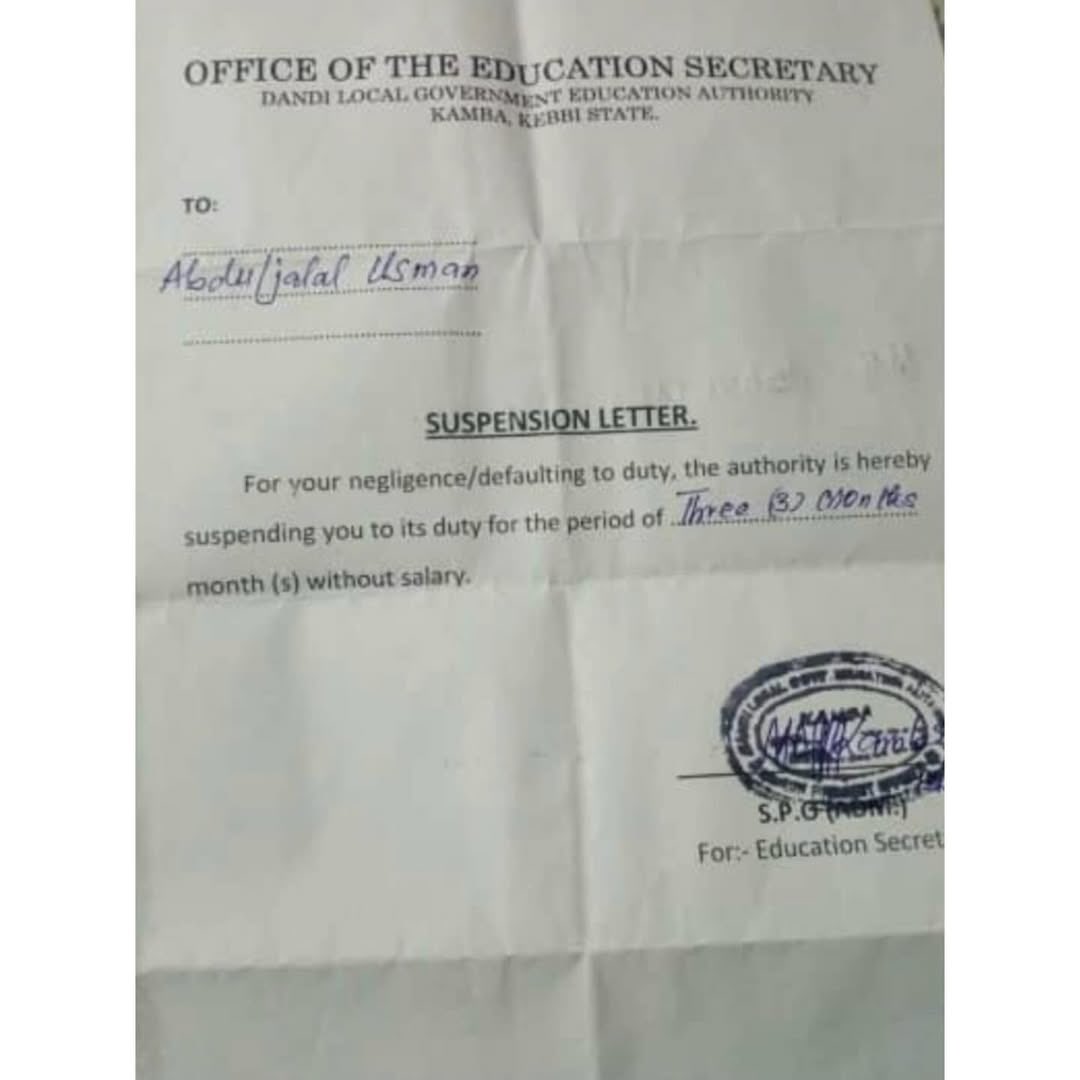
In a development that has sparked widespread condemnation across Kebbi State, a school teacher identified as Abduljalal Usman has been slapped with a three-month suspension without pay. The disciplinary action follows Usman’s public rejection of the state government’s Ramadan relief package and his subsequent criticism of the administration’s handling of poverty and governance.
According to reports emerging on Saturday, March 14, 2026, Usman had declined the government’s offering of "one mudu of maize and one mudu of millet"—a gesture intended to provide relief during the holy month of Ramadan. The teacher reportedly characterized the meager palliative as a "humiliation" and an attempt to "weaponize poverty" rather than address the systemic economic challenges facing civil servants in the state.
The "Negligence" Charge
The suspension letter, issued by the Education Secretary of the Dandi Local Government Education Authority (LGEA) in Kamba, officially accused Usman of "negligence and defaulting to duty." However, observers noted with concern that the letter failed to specify any actual professional failures or dates of absence that would typically justify such a severe penalty.
Details of the Disciplinary Action:
Duration: Three months effective immediately.
Financial Impact: Zero salary for the duration of the suspension.
Official Grounds: Negligence of duty.
Alleged Real Cause: Rejection of Ramadan palliatives and public criticism of Governor Nasir Idris.
Irony and Outcry
The suspension has drawn sharp criticism from civil society groups and labor advocates, many of whom pointed out the irony of the situation. Governor Nasir Idris, before entering politics, was a prominent labor leader and a classroom teacher himself, having served as the National President of the Nigeria Union of Teachers (NUT).
Critics argue that the Idris administration is setting a "dangerous precedent" by using administrative machinery to silence personal and political expression. Observers have described the move as an "abuse of power" and "bias," insisting that a teacher's private decision to reject a voluntary gift should never be conflated with their professional conduct in the classroom.
Analysis: The Politics of Palliatives
The "Mudu of Grain" controversy highlights the deep-seated tension between the state government’s "Renewed Hope" relief efforts and the growing dissatisfaction among civil servants over stagnant wages and the high cost of living. While the Kebbi government recently approved a two-hour reduction in working hours for the Ramadan period, the suspension of Abduljalal Usman suggests a zero-tolerance policy for any public servant who challenges the efficacy of these relief programs. For the teaching profession in Kebbi, this case serves as a chilling reminder of the shrinking space for dissent within the state's civil service.
“Under the leadership of Nasir Idris, the Kebbi State Government is now punishing teachers for refusing humiliation and for criticising the weaponisation of poverty.” — Anonymous Local Source